
Building-Integrated Agriculture (BIA)
Urban agriculture is increasingly critical to ensure nutritional security, community resilience, and equitable access to healthy foods for growing urban populations. However, lack of open space and high land prices present a constraint to establishment of new urban farms and gardens. A possible solution and a way to establish new agricultural sites, is to produce food on and in buildings, for example, through rooftop farming, green facades, and controlled environment agriculture.
In collaboration with Oregon State University and the University of Oregon, NUREC received funding from the United States Department of Agriculture’s National Institute of Food and Agriculture to assess and advance the state of building-integrated agriculture (BIA) in the United States. Our overall goal is to identify critical challenges, barriers, benefits, and opportunities and create a network of professionals to further develop BIA through academic training, applied research, extension programs, and industry engagement.
(Support for this project has been provided, in part, by the U.S. Department of Agriculture National Institute of Food and Agriculture (USDA NIFA). The views expressed in this website do not necessarily reflect the views of the funding agency or participating institutions.)
Find out more about BIA:
Do you have BIA expertise?
We are building a Rolodex of land grant university professionals to support BIA projects. Fill out this form to add your name to the list.
BIA White Paper Series
Building-Integrated Agriculture (BIA) represents a rapidly emerging field at the nexus of urban agriculture, architecture, and infrastructure systems. This series defines the field, establishes a shared language and explores applications across planning and practice.
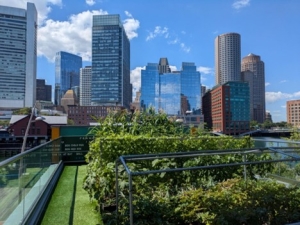
BIA: Defining an Emerging Field at the Intersection of Food and the Built Environment
This foundational paper introduces Building-Integrated Agriculture and outlines key concepts and opportunities.
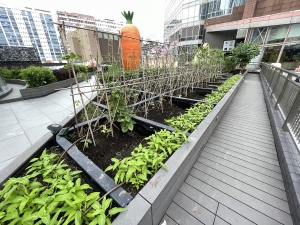
BIA and Urban Systems: Opportunities for Climate Resilience, Food Systems, and Community Wellbeing
Rather than viewing BIA solely as an agricultural innovation, this paper examines it through a municipal systems lens.
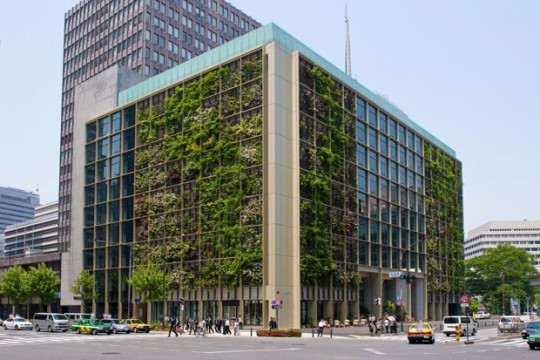
Coming soon!
New papers in the BIA series focusing on horticulture and controlled environment agriculture are in development. Check back or join our email list for the latest updates.
BIA Blog Posts
 https://nurec.extension.org/wp-content/uploads/2026/07/balcony-containers1-768x576-1.jpg
576
768
Martha
https://nurec.extension.org/wp-content/uploads/2024/03/NUREC-logo-website.png
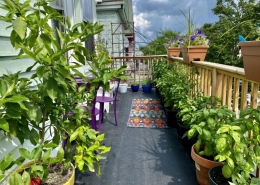
Martha2026-07-09 21:09:082026-07-09 21:28:39Lessons Learned from a Case Study in Urban Agriculture, and Considerations for Balcony Gardeners
https://nurec.extension.org/wp-content/uploads/2026/07/balcony-containers1-768x576-1.jpg
576
768
Martha
https://nurec.extension.org/wp-content/uploads/2024/03/NUREC-logo-website.png
Martha2026-07-09 21:09:082026-07-09 21:28:39Lessons Learned from a Case Study in Urban Agriculture, and Considerations for Balcony Gardeners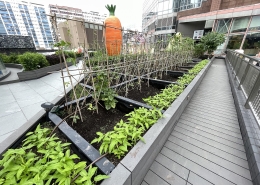 https://nurec.extension.org/wp-content/uploads/2026/04/Rooftop_Farm_in_Kwai_Chung_Hong_Kong.jpg
1440
1920
Martha
https://nurec.extension.org/wp-content/uploads/2024/03/NUREC-logo-website.png
Martha2026-07-09 18:40:512026-07-09 18:40:51What Is Building-Integrated Agriculture—and Why Does It Matter Now?
https://nurec.extension.org/wp-content/uploads/2026/04/Rooftop_Farm_in_Kwai_Chung_Hong_Kong.jpg
1440
1920
Martha
https://nurec.extension.org/wp-content/uploads/2024/03/NUREC-logo-website.png
Martha2026-07-09 18:40:512026-07-09 18:40:51What Is Building-Integrated Agriculture—and Why Does It Matter Now? https://nurec.extension.org/wp-content/uploads/2026/06/NUEC-26-BIA-Panel-Smiling-scaled.jpg
1928
2560
Maggie
https://nurec.extension.org/wp-content/uploads/2024/03/NUREC-logo-website.png
Maggie2026-06-16 21:07:302026-07-09 18:40:29NUREC Partners Highlight Building Integrated Agriculture and Knowledge & Practice Networks at the 2026 National Urban Extension Conference
https://nurec.extension.org/wp-content/uploads/2026/06/NUEC-26-BIA-Panel-Smiling-scaled.jpg
1928
2560
Maggie
https://nurec.extension.org/wp-content/uploads/2024/03/NUREC-logo-website.png
Maggie2026-06-16 21:07:302026-07-09 18:40:29NUREC Partners Highlight Building Integrated Agriculture and Knowledge & Practice Networks at the 2026 National Urban Extension Conference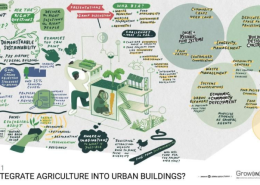 https://nurec.extension.org/wp-content/uploads/2026/07/growin-on-ag-768x430-1.png
430
768
Martha
https://nurec.extension.org/wp-content/uploads/2024/03/NUREC-logo-website.png
Martha2026-05-01 21:19:122026-07-09 21:38:13Cultivating Urban Agriculture: Recap of the Grow(in)’ On! Visioning Summit 2024
https://nurec.extension.org/wp-content/uploads/2026/07/growin-on-ag-768x430-1.png
430
768
Martha
https://nurec.extension.org/wp-content/uploads/2024/03/NUREC-logo-website.png
Martha2026-05-01 21:19:122026-07-09 21:38:13Cultivating Urban Agriculture: Recap of the Grow(in)’ On! Visioning Summit 2024Workshops and Other Activities
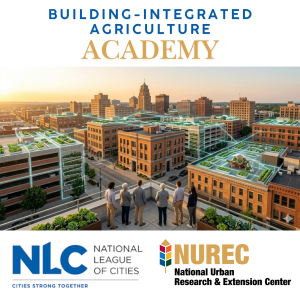
Apply now for BIA Academy – helping cities plan and implement agriculture and green systems into the built environment.
Building Integrated Agriculture (BIA) Academy, led by the NUREC in partnership with National League of Cities University, is a cohort program that supports municipal leaders in exploring BIA as a strategy for community and environmental resilience, sustainability, food access, and economic opportunity. Participants engage in self-paced learning, monthly expert-led sessions, peer exchange, and technical assistance, with a focus on applied learning and practical implementation. BIA Academy begins in Nov. 2026. The RFP and application are now available. Applications are due October 5th.

Join NUREC for our panel at the Urban Food Systems Summit, September 16, 2026
NUREC was invited to present a plenary panel session on BIA project at the Urban Food Systems Symposium: Designing Living Cities – Building-Integrated Agriculture and the Future of Urban Food Systems. The Urban Food Systems Symposium (UFSS) brings together a national and international audience of academic, non-profit, private-sector, government and research-oriented professionals around this years’ theme of ‘Cultivating Communities, Cities, and Food Systems.’ UFSS fosters collaboration and emphasizes the role of urban food systems in shaping sustainable solutions for our cities and communities.
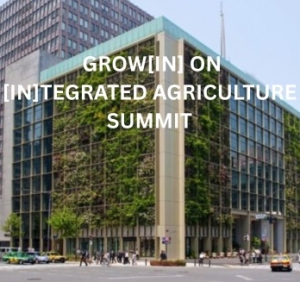
Grow[in] On Integrated Agriculture Summit
The goal of the Summit was to share learning, foster a professional learning community, and to identify the key research, education, implementation areas, and expertise needed for building a productive and innovative building-integrated agriculture ecosystem by integrating perspectives from academia (research, education, and Extension), local and regional government, industry, and the non-profit sectors.
Resources

The Resource Circularity Report: Reimagining Cities as Regenerative Ecosystems
Resource Circularity: Reimagining Cities as Regenerative Ecosystems is a June 2025 report from Perkins & Will that assesses the feasibility of incorporating Building-Integrated Agriculture (BIA) systems into the built environment and opportunities for resource circularity.

