
Building-Integrated Agriculture: Defining an Emerging Field at the Intersection of Food and the Built Environment
By Jody Norman and Brad Gaolach
Why Building-Integrated Agriculture Is Emerging Now
As cities confront rising food insecurity, intensifying climate pressures, aging infrastructure, and mounting demands for healthier, more resilient, and more connected communities, the built environment is increasingly recognized not only as a site that consumes energy, water, and materials, but as a site of opportunity. Buildings shape energy use, water flows, indoor air quality, public health, and community life. At the same time, food systems are under strain—constrained by land availability, fragmented supply chains, and limited integration with broader planning and development systems. These pressures are not separate. They intersect in ways that invite new forms of coordination across food production, architecture, policy, and community development.
Building-Integrated Agriculture (BIA) is emerging at this intersection. Rather than treating food production as external to urban infrastructure, BIA explores how agriculture can be intentionally integrated into new and existing buildings—through rooftop systems, controlled environments, facade integration, and closed-loop resource strategies that link building outputs such as heat, carbon dioxide, and greywater to agricultural inputs. While examples are increasing, the field remains diffuse, with activity occurring across research institutions, design firms, municipal pilot projects, and Extension programs, often without shared language or coordinated pathways for scaling.
This paper responds to that moment of emergence. BIA is not a single technology or program, but an evolving knowledge and practice field as well as an ecosystem (see Public Value: The BIA Ecosystem: How Sectors Intersect section below) shaped by multiple disciplines and institutional actors. At this stage of development, shared clarity is essential. This overview introduces a white paper series designed to define the field, identify current patterns and constraints, examine impacts across health, economy, and climate, and provide a shared framework for continued development.
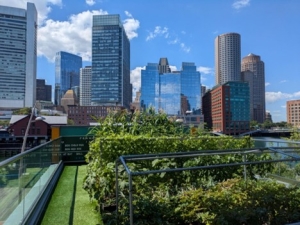
Rooftop garden site at the Boston Children’s Museum. Photo courtesy of Green City Growers. https://greencitygrowers.com/
Other papers in the BIA series
This paper is one in a series that defines the field of Building-Integrated Agriculture, establishes shared language, and explores applications across research, planning and practice.
What Counts as BIA
Building-Integrated Agriculture (BIA) refers to the intentional integration of agricultural production within the physical and operational systems of buildings. Unlike ground-based urban agriculture models such as community gardens or standalone urban farms, BIA embeds food production directly into new or existing structures through rooftop systems, interior controlled environments, facade integration, or other spatial configurations that link agricultural activity to the building envelope and infrastructure. In some cases, BIA projects may also incorporate or complement community-based programming.
BIA may be incorporated at the design stage of new construction or through the retrofit of existing buildings. In both cases, the defining feature is structural integration: food production is not simply co-located with a building, but coordinated with building systems such as energy, water, ventilation, waste streams, and occupancy patterns. This integration creates opportunities for circular resource strategies—for example, reusing waste heat, carbon dioxide, or greywater as inputs for agricultural production.
BIA also intersects with Controlled Environment Agriculture (CEA), particularly where food production occurs indoors under managed environmental conditions. However, not all CEA is building-integrated. Standalone or ground-based facilities may operate independently of broader building systems, whereas BIA emphasizes coordination between agriculture and architectural, mechanical, and regulatory frameworks (e.g., building codes, zoning, and permitting requirements).
Distinctions and Overlaps Among Building-Integrated Agriculture (BIA), Urban Agriculture, and Controlled Environment Agriculture (CEA)
| Points of comparison | Building-Integrated Agriculture (BIA) | Urban Agriculture | Controlled Environment Agriculture (CEA) |
|---|---|---|---|
| DEFINITION | Agricultural systems intentionally integrated into buildings, building systems, and infrastructure. | Food production occurring within urban environments. | Food production under controlled environmental conditions. |
| RELATIONSHIP TO BUILDINGS | Coordinated with building envelope, infrastructure, and operations | May occur near, within, or independent of buildings, but is not typically coordinated with building systems | May occur within buildings, greenhouses, or other structures, but building systems are not necessarily integrated into production operations. |
| DEFINING FEATURE | Integration of agricultural systems with buildings and infrastructure where food production is not the primary building use. | Urban location and food production within urban environments | Environmental control of growing conditions |
| CHARACTERISTICS | • Integrated with buildings • Connected to energy/water/waste systems • Coordinated with architectural and mechanical systems | • Ground-based or building-based • May be community-oriented, educational, nonprofit, or commercial. | • Controlled environmental conditions • Technology-enabled production systems • Production systems are not necessarily coordinated with building systems or infrastructure. |
| EXAMPLES | • Rooftop systems • Facade integration • Indoor growing environments connected to building operations | • Community gardens • Urban farms • Educational gardens • Market gardens | • Indoor vertical farms • Commercial greenhouses • Warehouse production • Hoop houses • High tunnels |
| TYPICAL SCALE/FOCUS | Integrated food production within the built environment; resource efficiency; multi-benefit outcomes | Range from community-focused initiatives to commercial food production within urban areas. | High-efficiency crop production and environmental control. |
By clarifying these distinctions, this series establishes a shared vocabulary that supports cross-sector collaboration. Definitional precision is not intended to narrow participation, but to strengthen alignment across disciplines that approach food production and the built environment from different vantage points.
Patterns and Constraints in the Current Landscape
Despite growing interest in integrating food production within the built environment, BIA remains an emerging and unevenly developed field, particularly in the United States. Innovation is occurring across domains—including agriculture, architecture, engineering, policy, and community development—but coordination among them remains limited.
Several structural gaps contribute to this fragmentation.
First, research capacity and data remain constrained. Although individual demonstration projects are increasing, there are few commercial-scale examples in the United States and limited longitudinal data on economic performance, environmental metrics, and social outcomes. This restricts the ability of cities, developers, and institutional owners to evaluate feasibility at scale.
Second, workforce development pathways are underdeveloped. BIA operates at the intersection of agriculture, architecture, engineering, policy, and community engagement—yet few training programs are structured to prepare professionals to work fluently across these domains. This creates a skills gap that affects both implementation and long-term operational success.
Third, institutional alignment is inconsistent. Municipal planning, building codes, food policy, and sustainability initiatives often operate in parallel rather than in coordinated frameworks. Without shared language and cross-sector collaboration, opportunities for integration can be missed at early design and policy stages.
Finally, definitional ambiguity has contributed to conceptual drift. Terms such as urban agriculture, controlled environment agriculture, green infrastructure, and food systems innovation are frequently used interchangeably, even when referring to distinct structural models. This ambiguity can hinder strategic planning and dilute the potential for scalable integration.
These gaps do not indicate failure. Rather, they signal a field in formation. As BIA evolves from experimental projects toward broader implementation, the need for structured synthesis, shared vocabulary, and coordinated pathways becomes increasingly important.
Shared Vocabulary for the BIA Field
The following working definitions are provided to support shared understanding across disciplines engaged in Building-Integrated Agriculture.
| TERM | WORKING DEFINITION | EXAMPLES |
|---|---|---|
| BUILDING INTEGRATED AGRICULTURE (BIA) | Agricultural production intentionally integrated into building systems and infrastructure | Rooftop farms, façade systems, indoor growing connected to energy or water systems |
| CONTROLLED ENVIRONMENT AGRICULTURE (CEA) | Food production under managed environmental conditions | Hydroponics, aquaponics, vertical farming, greenhouse systems |
| URBAN AGRICULTURE | Food production occurring within urban areas, often at ground level | Community gardens, urban farms, neighborhood growing spaces |
| CIRCULAR RESOURCE STRATEGIES | Reuse of outputs from one system as inputs for another | Waste heat reuse, greywater reuse, CO₂ capture for plant growth |
| GREEN INFRASTRUCTURE | Vegetated or ecological systems integrated into urban environments for environmental benefit | Green roofs, bioswales, vegetated walls |
| RETROFIT | Integration of systems into existing buildings or infrastructure | Converting rooftops or underused interior spaces for food production |
| FOOD SYSTEMS INNOVATION | New approaches to producing, distributing, or accessing food within changing social, environmental, or technological contexts | Controlled environment agriculture, local procurement systems, rooftop farming, circular resource strategies |
Public Value: Impacts Across Health, Economy, and Climate
BIA is not defined solely by where food is grown, but by how its integration reshapes multiple systems at once. When intentionally designed and coordinated, BIA can generate layered public value across health, economic, and environmental domains.
Physical and Holistic Health
When agriculture is visibly and physically integrated into buildings, occupants encounter living systems as part of daily life. Rooftop growing areas, interior cultivation spaces, and vegetated facades introduce light, greenery, and seasonal cycles into dense urban settings. A growing body of work on biophilic design and access to green space indicates that exposure to living plants can support psychological wellbeing and reduce stress [1]. In residential, educational, healthcare, and workplace environments, integrated food production can also improve access to fresh produce while strengthening community identity and food literacy. In this way, BIA connects environmental quality, human health, and social cohesion within the same built setting.
Economic Vitality and Workforce Development
BIA operates at the intersection of agriculture, construction, facilities management, and sustainability services. By embedding food production within buildings, it creates opportunities for new professional roles that require cross-disciplinary fluency—designers who understand agricultural systems, growers who understand building performance, and operators who manage both. These hybrid roles point toward emerging workforce pathways that bridge traditional sector boundaries. At the same time, long-term success depends on practical coordination: how the space is designed, how it is operated, and whether the model fits local demand. Evaluating these relationships is essential to moving BIA beyond pilot projects and toward broader adoption.
Climate Resilience and Resource Efficiency
Because BIA is embedded within the built environment, it can align directly with climate mitigation and adaptation strategies. Rooftop systems may help moderate building and city-wide temperatures; facade integration can contribute to shading and cooling; indoor production systems can allow food to be grown efficiently in dense, land-limited settings and year-round in cold weather climates. When coordinated with building infrastructure, agricultural operations can reuse waste heat, carbon dioxide, or water flows, reducing overall resource demand. In some contexts, integrating food production closer to points of consumption may also help reduce transportation demands, strengthen local or regional food system resilience, and contribute to broader green infrastructure and nature-based solution strategies that support environmental quality and community wellbeing. In this way, buildings can shift from being solely resource consumers to participating more actively in resource cycling.
Taken together, these domains illustrate why BIA warrants coordinated attention. Its potential lies not in isolated benefits, but in the integration of multiple outcomes within a single built framework. Recognizing these interconnections provides a foundation for understanding how different sectors intersect in advancing the field.
The BIA Ecosystem: How Sectors Intersect
Advancing BIA requires coordination among actors who do not traditionally operate within the same professional or institutional spaces. Because BIA sits at the intersection of food systems and the built environment, implementation depends on early and sustained collaboration across sectors. These collaborations are shaped not only by technical and operational considerations, but also by broader public goals related to climate resilience, food access, community wellbeing, and healthy built environments. Figure 1 outlines the ecosystem of actors and domains whose interactions shape whether building-integrated agriculture projects move from concept to implementation.
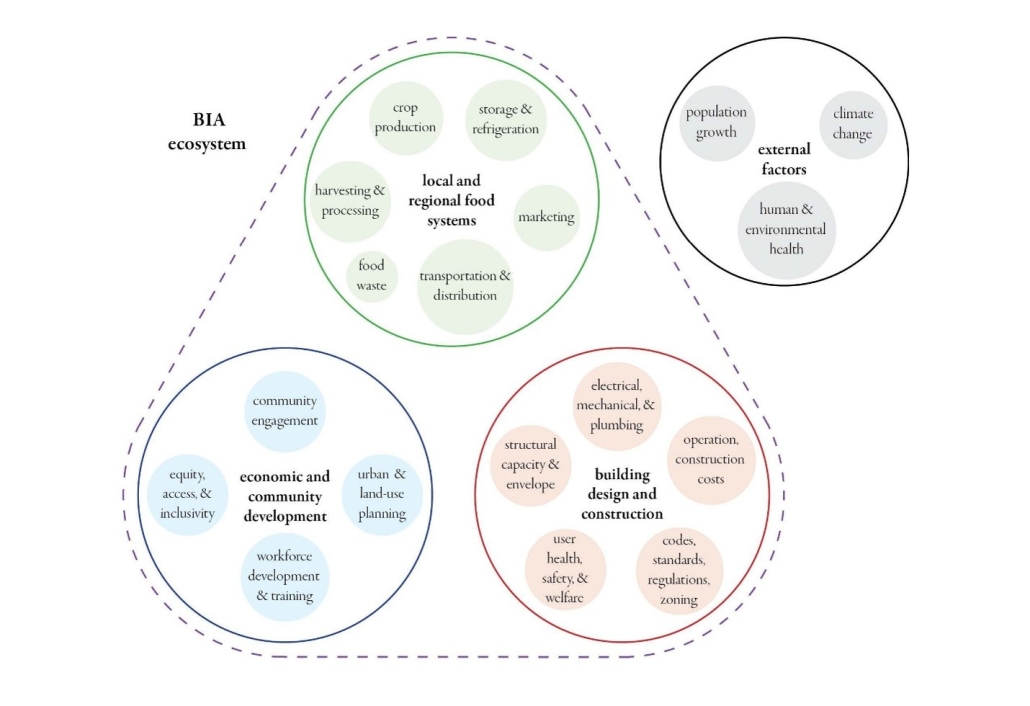
Figure 1: BIA ecosystem of stakeholder groups, systems, and processes. BIA projects emerge through interactions among municipal policy frameworks, the architecture/engineering/construction sector, agricultural operators, Cooperative Extension and research institutions, developers and building owners, and workforce training systems.
Municipal governments influence and incentivize what is possible through zoning, building codes, permitting processes, climate action plans, and food policy initiatives [2] [3] [4]. Early consideration of BIA within these frameworks can determine whether projects are encouraged, constrained, or overlooked entirely. Municipal leadership can also convene departments—planning, sustainability, public health, economic development—that rarely collaborate around food and building systems together [2] [3] [4].
Architecture, Engineering, and Construction (AEC) professionals translate ideas into physical form. Decisions about structural load, envelope design, mechanical systems, and energy modeling directly affect whether agricultural integration can be safely, effectively, and affordably incorporated into a building. Early engagement with agricultural expertise can prevent costly redesign and ensure that growing systems are treated as core components rather than afterthoughts.
Extension brings long-standing experience in applied research, community engagement, and workforce education, grounded in its role as a national system connecting land-grant universities with communities across the United States [5]. Extension professionals are uniquely positioned to build bridges between research institutions and the communities they serve—connecting municipal leaders, building owners, growers, and residents with practical evidence and locally relevant knowledge.
As BIA emerges at the intersection of food systems and the built environment, it creates both a need and an opportunity for Extension to expand this role. Prior work has highlighted the importance of Extension’s engagement in urban and metropolitan systems as part of its ongoing evolution [6]. By convening stakeholders, facilitating dialogue, and supporting training, Extension can help align emerging BIA research with real-world community needs and evolving workforce pathways, particularly in contexts where these systems converge.
Controlled Environment Agriculture operators and food-focused enterprises contribute technical expertise, operational experience, and market knowledge. While not all CEA facilities are building-integrated, operators in this space bring insights into crop systems, environmental controls, labor requirements, and distribution logistics that are essential for viable BIA projects. Partnerships between building owners, experienced growers, and urban food production enterprises can strengthen both design feasibility and long-term operational performance.
Developers and institutional building owners ultimately decide whether integrated agriculture becomes—and remains—part of actual projects. Their decisions reflect construction costs, operational responsibilities, revenue expectations, and long-term operation and maintenance considerations. For BIA to move beyond demonstration efforts, these practical factors must be addressed early and transparently.
Educational institutions and workforce training programs play a critical role in preparing professionals who can work across these intersecting domains.
No single actor can advance BIA independently, because its implementation depends on coordination across multiple systems and sectors. Whether projects move forward depends on coordinated decisions about policy, design, operations, market viability, and community engagement—especially in early planning stages, when key opportunities and constraints are established.
Building a Shared Framework for this BIA White Paper Series
The next papers in this white paper series will examine key system domains and their relationships through a series of focused lenses. Each paper will take one domain as a primary point of entry, exploring how it connects to other actors, what constraints shape those relationships, and where opportunities for alignment may exist.
Because these domains are interdependent, they will appear across multiple papers throughout the series. Each paper approaches them from a different point of entry, allowing recurring actors, relationships, and implementation challenges to be examined in new contexts as the series develops.
This approach allows individual papers to incorporate insights from interviews, case studies, and emerging practice while maintaining a clear focus on a specific domain or set of relationships. Together, the series is intended to build a more grounded and actionable understanding of how BIA may be implemented across sectors and institutional contexts.
Moving Forward
BIA is still taking shape as a field. Projects are emerging, terminology is evolving, and institutional roles are beginning to intersect in new ways. At this stage, clarity matters. Shared language, visible patterns, and practical questions can help prevent fragmentation and support more intentional collaboration.
This series is offered as a starting framework rather than a final word. By organizing current knowledge and identifying areas for further exploration, NUREC seeks to support informed dialogue across municipalities, design professionals, Extension systems, developers, researchers, and community partners. The goal is not to define the field narrowly, but to make its contours more visible and navigable.
As additional research, demonstration projects, and collaborative models develop, future papers can expand alongside them. In this way, the series provides a framework for shared learning, collaboration, and continued development as the field evolves.
Acknowledgements
This white paper was developed as part of NUREC’s Building-Integrated Agriculture (BIA) initiative supported through the U.S. Department of Agriculture National Institute of Food and Agriculture (USDA NIFA) and is part of a broader series exploring the opportunities, challenges, and future development of the field. The views expressed herein are those of the authors and do not necessarily reflect the views of the funding agency or participating institutions.
The authors thank Gail Ann Langellotto for her feedback and contributions during manuscript development. The authors also thank members of the Building-Integrated Agriculture working group for their feedback and contributions, including Maggie Sue Anderson, Martha Aitken, Gwynne Mhuireach, and Mark Fretz.
References
| [1] | C. Twohig-Bennett and A. Jones, “The health benefits of the great outdoors: A systematic review and meta-analysis of greenspace exposure and health outcomes,” Environmental Research, vol. 166, no. October, p. 628–637, 2018. |
| [2] | City of Boston, “Imagine Boston 2030,” 2017. |
| [3] | City of Denver, “Comprehensive Plan 2040,” 2019. |
| [4] | City of Seattle, “One Seattle Plan,” 2025. |
| [5] | E. G. Bickell, “The Agricultural Cooperative Extension System: An Overview,” 2024. |
| [6] | J. Fox, M. Ruemenapp, P. Proden and B. Gaolach, “A national framework for urban Extension,” Journal of Extension, vol. 55, no. 2, p. Article 21, 2017. |
| [7] | L. Barbett, S. Syropoulos and J. Capaozzoli, “Nature connectedness and well-being: Evidence from a multi-national investigation across 75 countries,” Journal of Environmental Psychology, vol. 110, no. Article 102895, 2026. |


