
Building-Integrated Agriculture and Urban Systems: Opportunities for Climate Resilience, Food Systems, and Community Wellbeing
By Jody Norman and Brad Gaolach
Why Cities Are Exploring New Urban Systems Approaches
Cities are increasingly being asked to address multiple challenges at once. Climate impacts, housing pressures, food insecurity, public health concerns, aging infrastructure, and resource constraints often intersect in ways that resist simple solutions. At the same time, municipal leaders are being asked to deliver outcomes that are not only effective within individual sectors, but that also generate benefits across multiple community priorities.
These pressures are contributing to growing interest in integrated approaches to urban resilience [1] [2] [3]. Rather than treating food systems, infrastructure, environmental sustainability, public health, and economic development as separate domains, many cities are exploring how investments in one area might support outcomes in others. This shift reflects a broader recognition that urban systems are deeply interconnected. Decisions about buildings, transportation, land use, energy, water, and food frequently influence one another in ways that create both opportunities and constraints.
Food systems provide one example of this interconnectedness. Food insecurity, supply chain disruptions, rising food costs, and limited access to fresh produce are often discussed as food system challenges. Yet these issues are also linked to transportation networks, land availability, public health outcomes, economic development strategies, and broader patterns of urban growth. Addressing these challenges may require coordination across sectors that have not traditionally worked together.
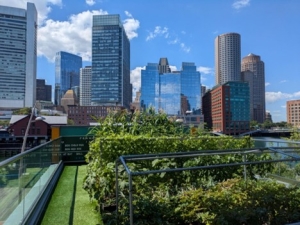
Rooftop garden site at the Boston Children’s Museum. Photo courtesy of Green City Growers. https://greencitygrowers.com/
Other papers in the BIA series
This paper is one in a series that defines the field of Building-Integrated Agriculture, establishes shared language, and explores applications across research, planning and practice.
Climate resilience presents similar dynamics. Cities are increasingly exploring approaches that simultaneously address heat mitigation, stormwater management, energy use, environmental quality, and community wellbeing. Nature-based solutions, green infrastructure, and other multifunctional strategies have gained attention in part because they offer the potential to support several goals at once rather than addressing each challenge independently.
Building-Integrated Agriculture (BIA) is emerging within this broader context. Interest in BIA is growing not because it addresses a single challenge, but because it intersects with multiple priorities cities are already working to advance. By integrating agricultural systems into buildings and the built environment, BIA positions buildings not only as consumers of resources, but as potential contributors to food production, climate resilience, resource efficiency, and community wellbeing.
Rather than viewing BIA solely as an agricultural innovation, this paper examines it through a municipal systems lens. By integrating agricultural functions into buildings and the built environment, BIA creates potential connections among food systems, climate resilience, resource efficiency, public health, workforce development, and other community priorities. These intersections create opportunities for collaboration across sectors while also raising questions related to implementation, governance, stakeholder engagement, and long-term capacity. The sections that follow explore how these opportunities and constraints may shape the role of BIA within broader municipal resilience and sustainability efforts.
What BIA is (and isn’t)
Building-Integrated Agriculture (BIA) refers to agricultural systems intentionally integrated into buildings, building systems, and infrastructure. These systems may include rooftop production, integrated greenhouse structures, indoor growing environments, façade-based systems, or other approaches that connect food production with the design and operation of buildings. As an emerging field, BIA draws from agriculture, architecture, engineering, planning, and environmental design, creating opportunities to explore how food production can contribute to broader urban goals.
Because BIA intersects with several related fields, it is often helpful to distinguish it from both urban agriculture and controlled environment agriculture (CEA). While these approaches may overlap with BIA in practice, they represent distinct concepts with different goals, design considerations, and relationships to buildings and infrastructure. Table 1 provides a high-level comparison of these overlapping but distinct approaches.
Table 1: Distinctions and Overlaps Among Building-Integrated Agriculture (BIA), Urban Agriculture, and Controlled Environment Agriculture (CEA)
| Points of comparison | Building-Integrated Agriculture (BIA) | Urban Agriculture | Controlled Environment Agriculture (CEA) |
|---|---|---|---|
| DEFINITION | Agricultural systems intentionally integrated into buildings, building systems, and infrastructure. | Food production occurring within urban environments. | Food production under controlled environmental conditions. |
| RELATIONSHIP TO BUILDINGS | Coordinated with building envelope, infrastructure, and operations | May occur near, within, or independent of buildings, but is not typically coordinated with building systems | May occur within buildings, greenhouses, or other structures, but building systems are not necessarily integrated into production operations. |
| DEFINING FEATURE | Integration of agricultural systems with buildings and infrastructure where food production is not the primary building use. | Urban location and food production within urban environments | Environmental control of growing conditions |
| CHARACTERISTICS | • Integrated with buildings • Connected to energy/water/waste systems • Coordinated with architectural and mechanical systems | • Ground-based or building-based • May be community-oriented, educational, nonprofit, or commercial. | • Controlled environmental conditions • Technology-enabled production systems • Production systems are not necessarily coordinated with building systems or infrastructure. |
| EXAMPLES | • Rooftop systems • Facade integration • Indoor growing environments connected to building operations | • Community gardens • Urban farms • Educational gardens • Market gardens | • Indoor vertical farms • Commercial greenhouses • Warehouse production • Hoop houses • High tunnels |
| TYPICAL SCALE/FOCUS | Integrated food production within the built environment; resource efficiency; multi-benefit outcomes | Range from community-focused initiatives to commercial food production within urban areas. | High-efficiency crop production and environmental control. |
Urban agriculture is broadly defined by location. It encompasses food production occurring within urban environments and may include community gardens, urban farms, educational projects, nonprofit initiatives, and commercial enterprises. Some urban agriculture projects may occur on rooftops or within buildings, while others are entirely ground-based. Urban location alone, however, does not make an initiative BIA. The defining characteristic of BIA is not simply where food is produced, but the intentional integration of agricultural systems with buildings, building operations, and the functions those buildings serve.
Controlled environment agriculture is defined by production methods rather than location. CEA systems use technologies to regulate growing conditions such as temperature, humidity, lighting, and nutrient delivery in order to optimize crop production. Vertical farms, commercial greenhouses, and other technology-enabled growing systems are common examples. Many BIA projects utilize CEA technologies, but environmental control alone does not make a project BIA. A growing system may operate within a building while remaining largely independent of the building’s broader infrastructure and operations.
What distinguishes BIA is the extent to which agricultural functions are coordinated with building systems and infrastructure. Water, energy, heat, carbon dioxide, waste streams, and other resources may be shared, recovered, or managed across systems in ways that create additional value beyond food production alone. This systems-oriented approach positions BIA not simply as a form of urban agriculture or a type of controlled environment agriculture, but as an emerging strategy for connecting food production with broader goals related to resilience, resource efficiency, and community wellbeing.
BIA as Built Environment Infrastructure
The distinctions described above are important because they influence how BIA is understood within urban systems. While urban agriculture is primarily defined by location and controlled environment agriculture (CEA) by environmental control, BIA is distinguished by its relationship to buildings and infrastructure. This relationship creates opportunities to think about food production as part of the built environment rather than as a separate activity occurring within it.
Cities manage networks of buildings that consume water, energy, materials, and land while generating heat, waste, and other outputs. Traditionally, these systems are managed separately, with buildings viewed primarily as consumers of resources rather than contributors to broader urban goals. As cities pursue sustainability and resilience objectives, there is growing interest in approaches that connect these systems in new ways.
BIA explores how agricultural systems can be incorporated into buildings so that food production becomes part of a broader network of urban functions. Rather than serving a single purpose, buildings may contribute simultaneously to food production, resource efficiency, environmental performance, and community wellbeing. This perspective expands the role of buildings beyond occupancy and operations, creating opportunities to support multiple community priorities through a single physical asset.
In some cases, water, heat, carbon dioxide, energy, or organic waste streams may be captured, reused, or redirected across systems. These interactions are often described as resource cycling and represent one way BIA differs from agricultural systems that operate independently of building infrastructure. While the specific approaches vary by project and context, the underlying principle is that resources traditionally treated as outputs or waste may become inputs for other functions within the system.
From a municipal perspective, these connections are often more significant than food production alone. Cities are increasingly interested in approaches that support multiple objectives simultaneously, including climate resilience, green infrastructure, resource efficiency, public health, food systems, and economic development. BIA has attracted attention because it offers one potential framework for exploring these intersections within the built environment.
These potential connections help explain why BIA is increasingly appearing within conversations about climate adaptation, nature-based solutions, food systems planning, and urban sustainability. The sections that follow explore several of the municipal priorities that are driving interest in these approaches and examine how BIA may contribute to broader urban resilience efforts.
Climate Resilience
Climate resilience provides one example of how cities are applying integrated approaches to complex urban challenges. As municipalities evaluate strategies for adapting to changing environmental conditions, there is growing interest in interventions that can contribute to multiple community priorities simultaneously. This shift has helped drive attention toward approaches that connect environmental performance, infrastructure, public health, and community wellbeing rather than addressing each objective independently.
Cities are increasingly exploring nature-based solutions, green infrastructure, and other multifunctional approaches that can generate benefits across multiple urban priorities simultaneously. Rather than addressing a single challenge in isolation, these strategies recognize that one intervention may contribute to a range of outcomes, including climate adaptation, ecosystem services, environmental quality, public health, and community wellbeing. This emphasis on interconnected outcomes is reflected in emerging nature-based solutions frameworks that recognize the multifunctional benefits of urban interventions across environmental, social, and economic systems. NUREC’s Nature-Based Solutions systems mapping work, for example, was developed to help practitioners and policymakers identify interventions capable of generating benefits across multiple sectors and stakeholder groups [4].
BIA shares many of the characteristics that have made nature-based and multifunctional approaches attractive to cities. Depending on design and context, building-integrated systems may contribute to food production, environmental performance, resource efficiency, and broader resilience goals simultaneously. Like other integrated urban strategies, BIA is often evaluated not only for a single outcome, but for its potential to support multiple community priorities through a shared physical and operational framework.
Depending on design and context, BIA may intersect with several climate resilience priorities that cities are already pursuing through climate action plans, sustainability strategies, resilience frameworks, and green infrastructure initiatives. Common municipal goals include reducing urban heat impacts, improving stormwater management, increasing vegetation within the built environment, strengthening local food systems, and enhancing community resilience to climate-related disruptions. Many cities are also emphasizing equitable resilience strategies that prioritize communities most vulnerable to climate impacts [2] [3]. Many of these plans also emphasize the importance of multifunctional infrastructure capable of delivering environmental, social, and economic benefits simultaneously [1] [2] [3]. Rooftop growing systems, green roofs, living walls, and other forms of building-integrated vegetation have been explored as potential contributors to these objectives. While outcomes vary across projects and locations, these approaches illustrate how food production and vegetation can be incorporated into the built environment in ways that support broader resilience goals. In this context, BIA may be viewed not as a single-purpose intervention, but as one example of how integrated urban systems can contribute to multiple municipal priorities simultaneously [1] [2] [3].
Community Wellbeing and Food Systems
Municipal food system discussions increasingly occur within broader conversations about community wellbeing, neighborhood quality, public health, and urban livability. Across many cities, concerns related to food access are often discussed alongside issues such as neighborhood services, public space, environmental quality, social connection, and resilience. Rather than viewing food systems solely through the lens of agricultural production, cities are increasingly exploring how food-related investments contribute to healthier, more connected, and more resilient communities [1] [2] [3].
This broader perspective reflects a growing recognition that wellbeing emerges from relationships among the built environment, social systems, and ecological systems. Access to healthy food, opportunities for social interaction, neighborhood walkability, environmental quality, access to nature, and community gathering spaces can all influence quality of life and public health outcomes. As a result, municipal efforts to improve community wellbeing frequently intersect with planning, housing, transportation, parks, environmental stewardship, and food systems [1] [2] [3] [5].
Within this context, BIA represents one of several approaches that may contribute to multiple community objectives simultaneously. When agricultural systems are visibly and physically integrated into buildings, occupants encounter living systems as part of daily life. Rooftop growing areas, interior cultivation spaces, and vegetated facades can introduce greenery, seasonal cycles, and food production into dense urban environments while also creating opportunities for community engagement and education.
A growing body of work on biophilic design and access to green space suggests that exposure to living plants may support psychological wellbeing and reduce stress [6] [7]. In residential, educational, healthcare, and workplace settings, integrated food production may also improve access to fresh produce while strengthening food literacy, environmental awareness, and community identity [5] [7]. In this way, BIA has the potential to connect environmental quality, human wellbeing, and social cohesion within the same built setting.
Workforce Development and Economic Opportunity
Cities increasingly view workforce development and economic opportunity as important components of resilience and sustainability planning [1] [2] [3] [8] [9]. Economic vitality, workforce access, entrepreneurship, innovation, and equitable opportunity frequently appear alongside discussions of climate resilience, infrastructure investment, community wellbeing, and neighborhood development. Rather than treating workforce development as a separate objective, many municipalities are exploring how investments in one area can also support economic mobility, local business development, and long-term community capacity.
This perspective reflects a broader shift toward integrated approaches to urban development. As cities invest in climate adaptation, green infrastructure, public facilities, housing, transportation systems, and other community assets, new workforce needs often emerge [8] [10] [11]. Planning, implementation, operations, maintenance, community engagement, and performance evaluation may require expertise that crosses traditional professional boundaries. In many cases, the challenges cities are attempting to address are themselves interdisciplinary, creating demand for individuals and organizations capable of working across sectors. Similar trends are emerging across green infrastructure, public space, and resilience initiatives, where workforce development programs increasingly combine technical, environmental, operational, and community-oriented skill sets.
BIA illustrates this trend. Because BIA operates at the intersection of agriculture, architecture, engineering, construction, planning, sustainability, and facility operations, implementation often requires collaboration among professionals with different areas of expertise. Projects may involve building owners, architects, engineers, growers, landscape professionals, planners, educators, public agencies, and community organizations working together to achieve multiple objectives within the same built environment.
As BIA and related approaches continue to evolve, they may contribute to the emergence of new workforce pathways and hybrid professions [9] [10] [12]. These roles may combine technical, environmental, operational, and community-focused skills that do not fit neatly within traditional disciplinary categories. While workforce needs will vary across projects and locations, the broader trend reflects a growing interest in professional capacities that support integrated urban systems. In this sense, workforce development is not simply an outcome of implementation, but an important component of how cities build long-term resilience, adaptability, and innovation capacity.
Municipal Implementation Pathways
Cities typically advance new initiatives through existing planning, policy, and investment frameworks rather than through entirely new programs [1] [2] [3]. Comprehensive plans, climate action plans, resilience strategies, food system initiatives, economic development efforts, and green infrastructure programs often provide the structures through which municipal priorities are identified and implemented. As a result, opportunities for BIA are likely to emerge where food production, environmental performance, community wellbeing, and economic development goals intersect with broader municipal objectives.
This intersectional nature means that BIA does not fit neatly within a single department or policy area. Depending on local priorities and project design, implementation may involve planning, sustainability, public health, economic development, housing, parks, utilities, or public works functions. In many cases, successful implementation may require coordination among organizations and sectors that do not traditionally collaborate around food production. This reflects a broader trend in municipal governance toward integrated approaches that address multiple community priorities simultaneously.
Because BIA remains an emerging field, implementation is likely to occur incrementally through pilot projects, demonstration sites, partnerships, and other forms of applied experimentation. These approaches allow communities to evaluate local opportunities, constraints, costs, and benefits while building familiarity among stakeholders. Public facilities, educational campuses, mixed-use developments, affordable housing projects, institutional campuses, and neighborhood-scale initiatives may provide opportunities to explore how integrated food production can contribute to local goals.
Municipal implementation pathways will vary considerably across communities. Local priorities, governance structures, climate conditions, available resources, and stakeholder interests all influence how new approaches are evaluated and adopted. As cities continue to explore strategies that support resilience, wellbeing, environmental performance, and economic opportunity, questions of implementation become closely connected to questions of governance, participation, and decision-making. Understanding who is involved in shaping these discussions may therefore be as important as the technical characteristics of individual projects.
Stakeholder Inclusion and Governance
Cities increasingly recognize that successful implementation depends not only on technical solutions, but also on the relationships, partnerships, and governance structures that support decision-making [1] [2] [3]. Comprehensive planning, resilience initiatives, community development efforts, and infrastructure investments frequently emphasize stakeholder engagement, collaboration, and public participation as important components of long-term success. As cities explore integrated approaches to complex challenges, questions of who participates in planning processes—and how decisions are made—become increasingly important.
Because BIA operates at the intersection of multiple systems, it also brings together a diverse range of stakeholders. Depending on local priorities and project design, these may include planners, architects, engineers, developers, building owners, food system organizations, public health practitioners, workforce development partners, community-based organizations, educational institutions, public agencies, and neighborhood residents. While these groups may share overlapping interests, they do not always participate in the same planning or decision-making processes.
The stakeholders involved in planning and implementation often influence which goals receive attention, which outcomes are measured, and which benefits are prioritized. As a result, stakeholder visibility can shape how opportunities and challenges are understood. Participants who are routinely engaged in planning discussions may have greater influence over project objectives and evaluation criteria, while perspectives from other sectors or communities may be less visible. For emerging approaches such as BIA, this raises important questions about how diverse forms of expertise, lived experience, and local knowledge are incorporated into planning and implementation efforts.
Municipal planning documents and emerging nature-based solutions frameworks increasingly emphasize collaboration, equity, participation, and inclusive decision-making as important elements of resilient communities [1] [2] [3] [4]. These approaches recognize that complex urban challenges often require coordination across multiple sectors and stakeholder groups. Within the context of BIA, these principles suggest that implementation involves more than the integration of agricultural systems with buildings and infrastructure. It also involves navigating relationships among the individuals, organizations, and communities that help shape project goals and outcomes. Understanding who is involved in these conversations—and who may be absent from them—may therefore be an important consideration as cities evaluate opportunities for future implementation.
Moving Forward
Cities are increasingly being asked to address complex challenges that extend across traditional policy and organizational boundaries. Climate resilience, food systems, community wellbeing, economic opportunity, infrastructure performance, and equitable development are often discussed as interconnected priorities rather than isolated concerns. As a result, municipal leaders are increasingly exploring approaches capable of contributing to multiple community objectives simultaneously.
Within this context, Building-Integrated Agriculture (BIA) represents one example of how food production, buildings, and infrastructure may be connected in new ways. As discussed throughout this paper, potential areas of intersection include climate resilience, community wellbeing, food systems, workforce development, and broader sustainability goals. While BIA is not a universal solution and may not be appropriate in every setting, its relevance stems from the possibility of contributing to outcomes that cities are already working to achieve.
The municipal plans examined in this paper suggest that cities are increasingly focused on resilience, health, livability, equity, and long-term community capacity [1] [2] [3]. They also highlight growing interest in multifunctional investments capable of delivering environmental, social, and economic benefits simultaneously. Viewed through this lens, BIA becomes less a question of agriculture alone and more a question of how integrated approaches can support broader community priorities.
As cities continue to explore new strategies for addressing interconnected challenges, opportunities may emerge to evaluate where and how BIA can contribute within local contexts. Future implementation will depend on local goals, available resources, stakeholder interests, governance structures, and community needs. Ultimately, the question is not whether every city should pursue BIA, but where, when, and under what conditions it may provide meaningful value as part of broader efforts to build resilient, healthy, and thriving communities.
Acknowledgements
The author would like to thank members of the Building-Integrated Agriculture (BIA) team and collaborators who contributed feedback, discussion, and review during the development of this paper. Particular thanks to Maggie Anderson for identifying relevant resources and connections to the BIA Academy curriculum, and to colleagues who provided comments, suggestions, and editorial review throughout the drafting process. Their insights helped strengthen the paper’s municipal systems perspective and its exploration of how BIA may intersect with broader urban resilience, wellbeing, and sustainability goals.
Funding and Support
This work was developed as part of the Building-Integrated Agriculture (BIA) initiative supported through the U.S. Department of Agriculture National Institute of Food and Agriculture (USDA NIFA). The views expressed in this paper are those of the author and do not necessarily reflect the views of the funding agency or participating institutions.
References
| [1] | City of Denver, “Comprehensive Plan 2040,” 2019. |
| [2] | City of Seattle, “One Seattle Plan,” 2025. |
| [3] | City of Boston, “Imagine Boston 2030,” 2017. |
| [4] | E. Blondell, “Nature-Based Solutions,” National Urban Research & Extension Center (NUREC). |
| [5] | M. Sargolini, A. Sopina, V. Polci, D. Mariani, C. Paolini and M. Mariani, “Integrating Urban Design, Healthy Habits, and Socio-Ecological Networks: A One Health and Well-Being Framework for Sustainable Cities,” Sustainability, vol. 17, no. 22, p. 10014, 2025. |
| [6] | G. Gonçalves, C. Sousa, M. J. Fernandes, N. Almeida and A. Sousa, “Restorative Effects of Biophilic Workplace and Nature Exposure during Working Time: A Systematic Review,” International journal of environmental research and public health, vol. 20, no. 21, p. 6986, 2023. |
| [7] | T. Beatley, Biophilic Cities: Integrating Nature into Urban Design and Planning, Island Press, 2010, p. 208. |
| [8] | M. Bogle and D. Harvey, “How Local Green Infrastructure Projects Can Create Pathways to Economic Opportunity,” Urban Institute, 2026. [Online]. Available: https://www.urban.org/urban-wire/how-local-green-infrastructure-projects-can-create-pathways-economic-opportunity. |
| [9] | J. Kane and A. Tomer, “Why green jobs plans matter and where US cities stand in implementing them,” Brookings Metro, 2023. |
| [10] | Green Infrastructure Workforce Collaborative, “Building a Sustainable and Equitable Green Infrastructure Workforce: Learnings from the Green Infrastructure Workforce Collaborative,” 2023. |
| [11] | GSI Impact Hub, “Job Creation & Economic Development Benefits of Green Stormwater Infrastructure (Summary),” GSI Impact Hub, 2024. |
| [12] | High Line Network, “High Line Network’s latest publication shows how parks and public spaces can drive inclusive workforce development,” City of New York, 2025. |


