
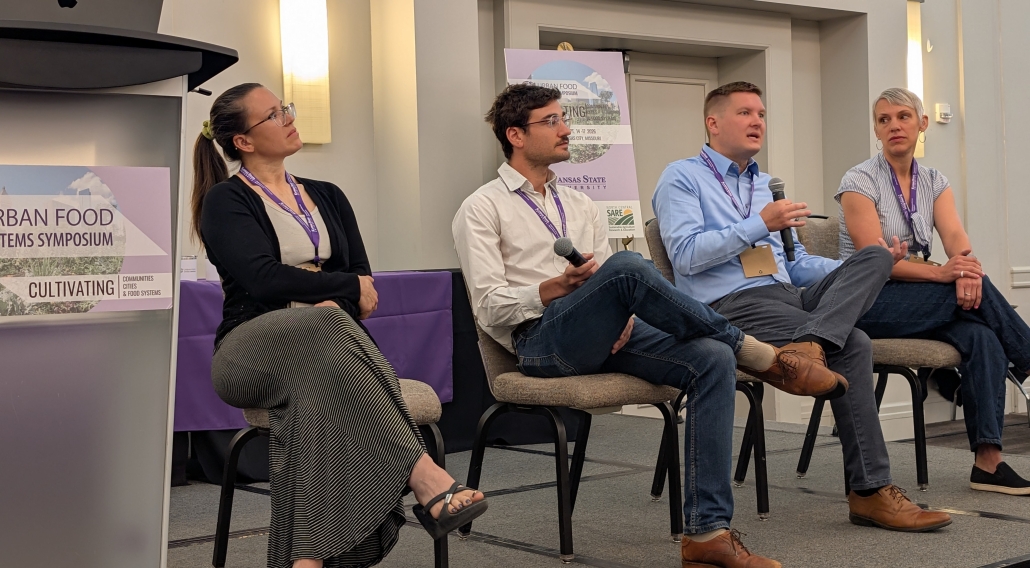
Left to right: Gwynne Mhuireach and August Stolba (both University of Oregon), Matt Arrington (Brigham Young University), and Meg Horst (Energy Trust Oregon) present at the 2026 Urban Food Systems Symposium. (photo/Brad Gaolach)
NUREC presents at the 2026 Urban Food Systems Symposium
NUREC traveled to Kansas City, MO to present at the 2026 Urban Food Systems Symposium: Cultivating Communities Cities & Food Systems, sponsored by Kansas State University. Since 2016, the Urban Food Systems Symposium has served as a biennial gathering space for researchers, educators, growers, nonprofit leaders, and students, that fosters collaboration and emphasizes the role of urban food systems in shaping sustainable solutions for our cities and communities. NUREC Director, Brad Gaolach, served on the Organizing Committee for the symposium.
Designing Living Cities — Building-Integrated Agriculture and the Future of Urban Food Systems
Moderated by Gwynne Mhuireach (University of Oregon) with August Stolba (University of Oregon), Matt Arrington (Brigham Young University), and Meg Horst (Energy Trust Oregon), NUREC’s panel brought together architects, planners, plant scientists, microbiome researchers, and food-systems experts to explore how Building-Integrated Agriculture (BIA) and regenerative urban food systems can transform the way cities function and thrive. Drawing from applied research across building science, ecology, vertical farming, and community-based planning, the panel highlighted how emerging knowledge—from plant-specific lighting needs to microbial interactions within built environments—can inform designs that support food production inside and atop buildings.
Panelists shared insights into how policy, technology, and design can converge to support more resilient, just, and climate-positive cities. A central theme of the discussion was collaboration: how interdisciplinary partnerships can turn buildings into living systems; how practitioners and researchers can co-create solutions with communities; and how integrating food production into the built environment can strengthen local food systems, improve health outcomes, and expand urban resilience. The panel shared real-world examples and alongside actionable pathways for bringing together science, design, and community priorities to build the next generation of living, food-producing cities.
###


