
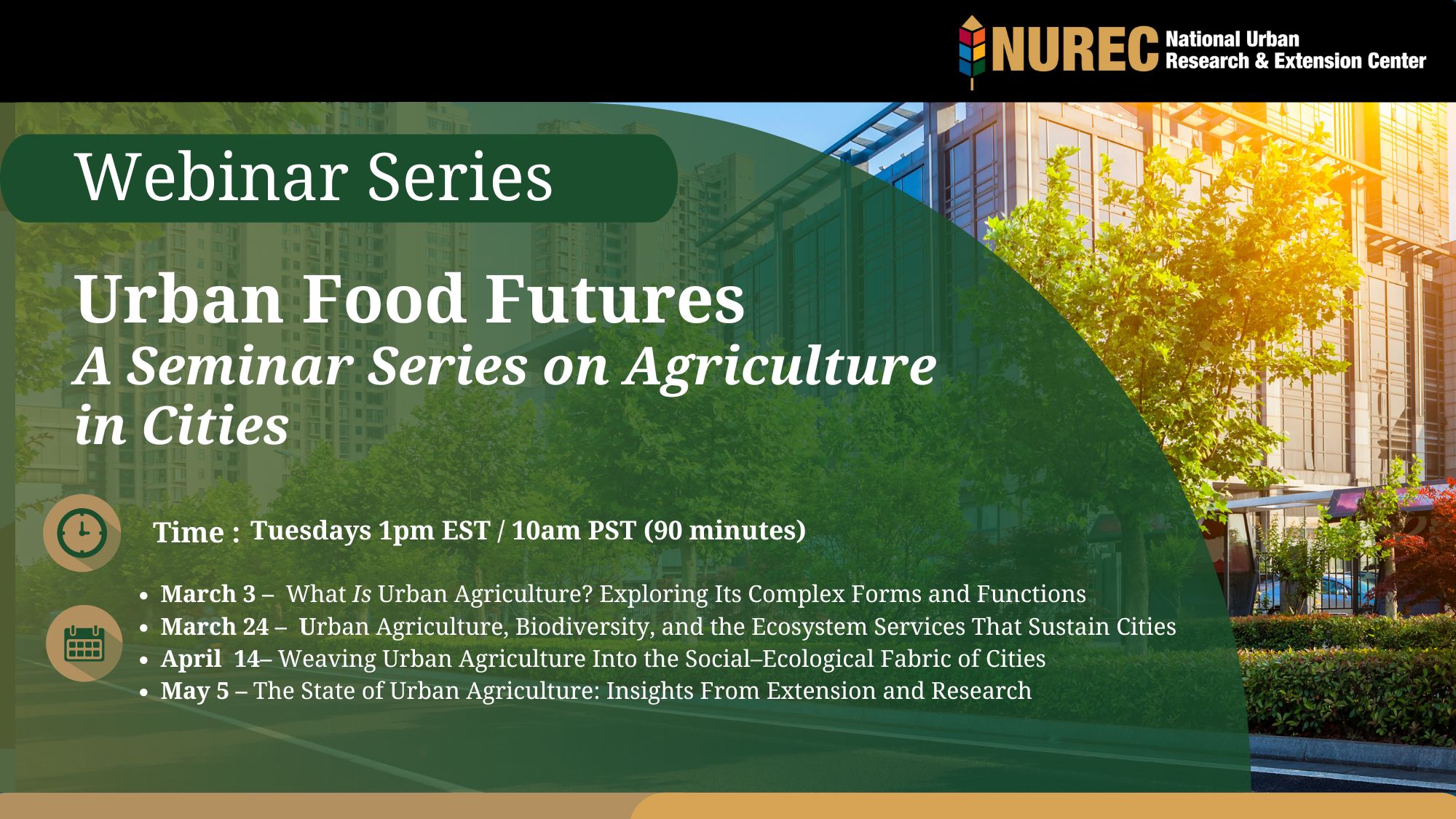
ICYMI: Part III – Urban Food Futures Seminar Highlights
The following is a summary of Session 3: Urban Agriculture, Biodiversity & Ecosystem Services, which took place on April 14th, 2026, 10-11:30 am PST / 1-2:30 pm EST
Urban Agriculture as Social Infrastructure: Lessons from Session Three of the Urban Food Futures Series
Urban agriculture is often discussed in terms of yields, efficiency, or economic viability. But during Session Three of NUREC’s Urban Food Futures Seminar Series, speakers collectively made a compelling case for a broader—and more impactful—frame: urban agriculture as social infrastructure.
Focusing on the social and economic impacts of urban agriculture, this session highlighted how community gardens, urban farms, and grassroots food projects function as sites of cultural continuity, political organizing, public health support, and community resilience—especially in cities shaped by inequality and ongoing crisis.
For Extension researchers and practitioners, the session offered important insights into how urban agriculture should be supported, studied, and sustained moving forward.
Urban Agriculture Is More Than Food Production
Dr. Antonio Roman‑Alcalá (California State University, East Bay; Agroecology Organizing Project) opened the session by emphasizing that urban agriculture generates multiple forms of value beyond food.
These include:
- Cultural and agro‑biodiversity, especially through the foodways of migrant and diasporic communities
- Social cohesion and place‑making in neighborhoods affected by displacement and precarity
- Environmental stewardship rooted in lived experience
- Political capacity building through mutual aid, food justice, and collective organizing
Urban agriculture, Roman‑Alcalá argued, often serves as an entry point—inviting people to engage with food systems hands‑on, while also revealing the limits of localized food production within broader economic and political structures.
For Extension, this underscores the need to avoid framing urban agriculture solely as a technical or entrepreneurial endeavor. Its deepest impacts often occur where community relationships, values, and power are being built.
The Central Barrier: Land and Power
A key through‑line of the session was the role of land access. Across decades of practice and research, challenges related to land tenure—short‑term leases, speculative markets, and private property regimes—remain the biggest constraint on urban agriculture’s long‑term impact.
Roman‑Alcalá emphasized that:
- Temporary or incentive‑based land access often reproduces inequality
- Market‑driven land systems limit food justice outcomes
- More transformative approaches include community land trusts, public land stewardship, and land reform frameworks
Without secure land access, urban agriculture remains vulnerable—no matter how successful it is socially or ecologically.
For Extension practitioners, land policy and governance are not peripheral issues. They are central to enabling sustainable, community‑led food systems.
Community Gardens as Social Infrastructure
Dr. H. Shellae Versey (Fordham University) brought a psychological and community‑based lens to the conversation, drawing from qualitative research conducted with Black farmers and community gardeners across multiple states.
In these interviews, growers consistently described community gardens not just as places to grow food, but as:
- Spaces for dignity, healing, and leadership development
- Informal safety nets during moments of crisis
- Sites for political education and voice
- Less stigmatizing alternatives to formal food assistance
Crucially, these themes emerged organically. Gardeners spoke about survival, care, and responsibility to their communities, not program metrics.
Versey framed community gardens as a form of social infrastructure—similar to libraries or parks—providing public value that far exceeds their physical footprint.
For Extension, this reinforces the importance of recognizing social and psychological outcomes as core impacts, not secondary benefits.
Gardening Across Acute and Chronic Crises
Lucy Diekmann and Laura Vollmer (UC Cooperative Extension) expanded the discussion by situating urban gardening within both acute crises and chronic structural conditions.
Drawing from a literature review published in Crisis Gardening: A Global Perspective, they described two overlapping contexts:
- Acute crises: pandemics, wars, natural disasters—moments when gardening often receives increased attention and support
- Chronic crises: food apartheid, housing insecurity, environmental injustice—long‑standing conditions that shape everyday life
While gardening during acute crises can increase food access and community connection, Diekmann and Vollmer showed that the greatest and most enduring benefits emerge when gardening is embedded within long‑term struggles for food justice and sovereignty.
This distinction matters for Extension. Short‑term surges of funding or interest—followed by withdrawal—undermine the continuity that community‑based food systems require.
Implications for Extension Research and Practice
Across perspectives, several key takeaways emerged for Extension professionals working in urban contexts.
1. Redefine What “Success” Looks Like
Traditional metrics—pounds harvested, revenue generated, number of participants—capture only part of the picture. Extension programs should also document:
- Community governance and leadership
- Cultural relevance of food
- Stability of land access
- Strength of social networks
- Contributions to food sovereignty and resilience
2. Engage Directly with Land and Policy
Land access, zoning, and governance shape every outcome in urban agriculture. Extension can play a vital role by:
- Supporting community land trusts and shared stewardship models
- Translating land‑use policy into accessible guidance
- Convening food, housing, and planning stakeholders
- Documenting unintended harms of “temporary use” approaches
3. Center Participatory Research and Co‑Creation
The strongest insights presented in this session came from:
- Oral histories and qualitative methods
- Community‑defined research questions
- Long‑term partnerships built on trust
Extension is uniquely positioned to bridge academic research, lived experience, and practice.
4. Plan Beyond Crisis Cycles
Urban agriculture cannot be mobilized only during emergencies. Sustainable impact requires:
- Baseline public investment
- Integration with health, housing, and climate strategies
- Capacity building before, during, and after crises
5. Reject False Binaries
Speakers challenged common divides—urban vs. rural, market vs. community, emergency vs. long‑term change. Instead, they pointed to the importance of interdependence, solidarity, and connection across food systems.
Looking Ahead
Session Three made clear that urban agriculture is not a niche or temporary solution. It is a longstanding, evolving practice that sits at the intersection of food, land, health, and justice.
For Extension and research institutions committed to equitable urban futures, the challenge is not whether to engage with urban agriculture—but how deeply, how thoughtfully, and how sustainably.
As NUREC continues to convene conversations and build national networks around urban food systems, these insights will be critical for shaping research agendas, Extension practice, and policy engagement that truly serve urban communities.
Speaker Bios
Antonio Roman‑Alcalá, MS
Assistant Professor, California State University, East Bay
Director, Agroecology Organizing Project
Antonio Roman‑Alcalá is an educator, researcher, and long‑time urban agriculture practitioner focused on agroecology, food sovereignty, land access, and social movements. He co‑founded San Francisco’s Alemany Farm and the San Francisco Urban Agriculture Alliance, and brings over two decades of experience connecting grassroots organizing, policy, and scholarship in urban food systems.
Links:
H. Shellae Versey, PhD
Associate Professor of Psychology, Fordham University
Principal Investigator, Critical Health + Social Ecology Urban Living Lab
Dr. Shellae Versey is a community and social psychologist whose research examines how place, policy, and structural inequities shape health, aging, and access to basic needs such as food and housing. Her work centers the lived experiences of Black and other marginalized urban communities, including research on urban agriculture as a pathway to food sovereignty and community resilience.
Links:
Lucy Diekmann, PhD
Urban Agriculture and Food Systems Advisor
University of California Cooperative Extension (Santa Clara & San Mateo Counties)
Dr. Lucy Diekmann is an Extension advisor and researcher working at the intersection of urban agriculture, food security, and food justice in high‑cost metropolitan regions. Her work examines how community and home gardening contribute to nutrition, social connection, and resilience, and she is a contributing author to Crisis Gardening: A Global Perspective.
Links:
Laura Vollmer, MPH, RD
Community Nutrition and Health Advisor
University of California Cooperative Extension (San Francisco, San Mateo & Santa Clara Counties)
Laura Vollmer is a registered dietitian and Extension advisor specializing in nutrition security, community food systems, and equitable food access. Her work integrates public health, evaluation, and community‑based practice, including research on gardening and food systems during acute and chronic crises.
Links:


