
ICYMI: Part II – Urban Food Futures Seminar Highlights
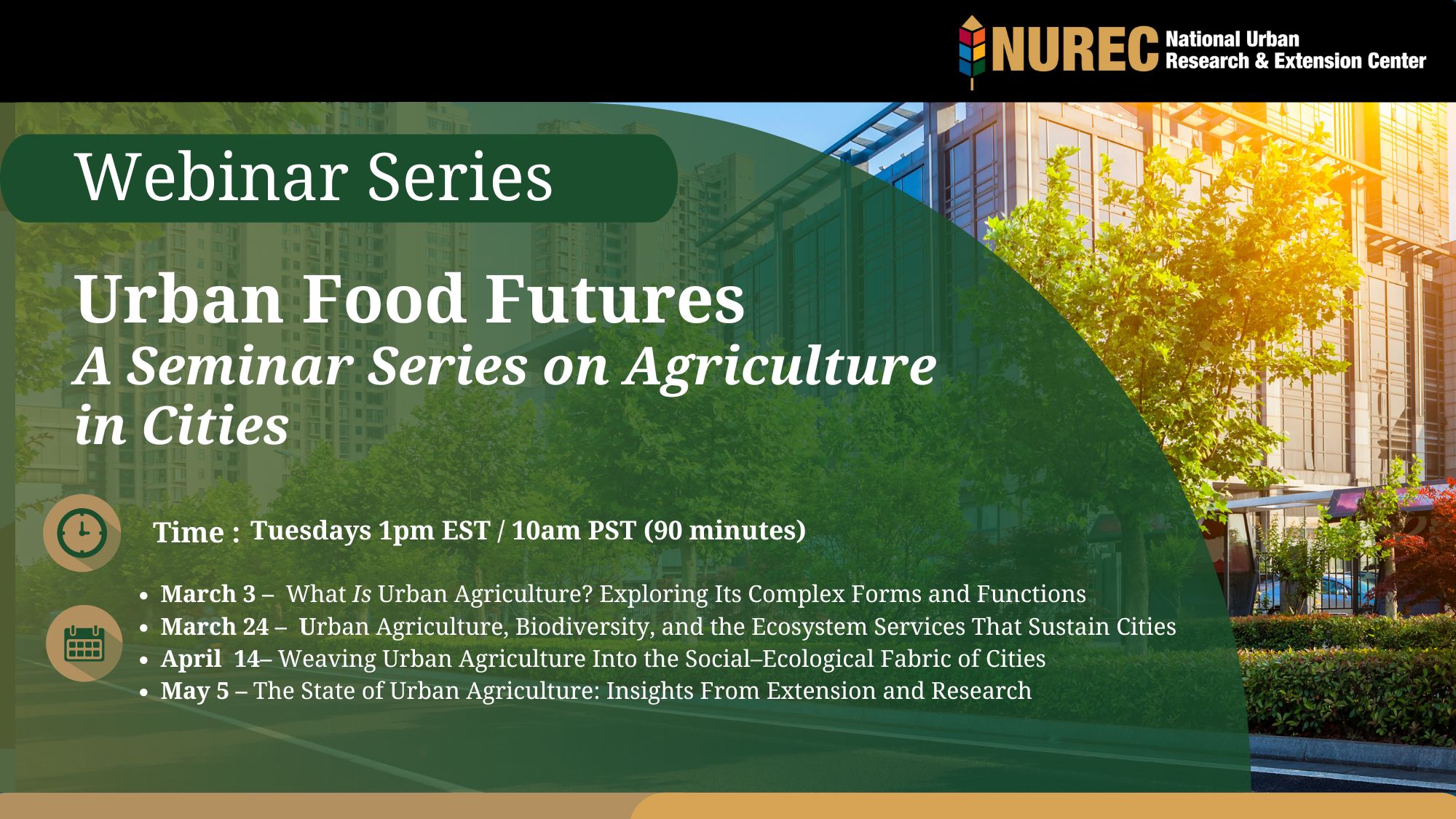
The following is a summary of Session 2: Urban Agriculture, Biodiversity & Ecosystem Services, which took place on March 24th, 2026 10-11:30 am PST / 1-2:30 pm EST
Urban Food Futures Seminar: Urban Agriculture, Biodiversity & Ecosystem Services
Urban agriculture is often framed as a strategy to improve food access—but those working on the ground know it’s much more than that. In cities, farms and gardens are deeply connected to public health, environmental quality, biodiversity, climate resilience, and community well‑being.
As part of the Urban Food Futures Seminar Series, hosted by the National Urban Research and Extension Center (NUREC), we recently welcomed three great speakers whose research helps illuminate these connections. It’s our pleasure to highlight the work of urban agriculture researchers and practitioners who are asking hard questions, sharing practical insights, and advancing more equitable and sustainable urban food systems.
At NUREC, our role is to bring collaborators together—to create space for learning across disciplines, institutions, and communities. This seminar was a powerful example of what happens when we do just that. Below, we share key themes and takeaways from the conversation, with a focus on why they matter for Extension and its partners.
Why Urban Agriculture—and Why Collaboration Matters
The seminar opened with framing from Joshua Arnold (UMass Amherst and NUREC), who reflected on NUREC’s mission and the growing importance of coordination across land‑grant universities in urban settings.
Urban agriculture today touches far more than food production. It intersects with nutrition and food access, certainly, but also with climate adaptation, heat mitigation, workforce development, youth leadership, and neighborhood revitalization. At the same time, Extension systems were largely built with rural contexts in mind, and urban efforts have often emerged in piecemeal ways.
NUREC exists to help bridge those gaps—by strengthening national collaboration, supporting community‑engaged research, and translating applied science into scalable Extension practice. The seminar made clear that urban agriculture is not a side project for Extension; it’s central to how the system stays relevant and responsive in metropolitan regions.
Soil Safety, Urban History, and Community Health
Dan Brabander (Wellesley College) shared lessons from nearly 20 years of participatory action research with The Food Project in Boston, focusing on lead contamination in urban soils.
His findings were sobering. Across residential growing spaces, most soils tested exceeded EPA benchmarks for lead. This contamination was not random—it closely followed patterns of redlining, disinvestment, and arson‑for‑hire, which released lead into the environment when older homes were burned. Even today, contaminated dust continues to move through neighborhoods, settling into pathways, compost, and raised beds.
Raised beds—often promoted as a universal solution—do reduce exposure risks, but only when thoughtfully designed. Bed height, placement near buildings, and compost quality all matter. In some cases, municipal compost programs can inadvertently reintroduce contamination if feedstocks come from legacy‑polluted areas.
For Extension, the takeaway is clear: urban soil safety is fundamentally a community health and equity issue, not just a gardening concern. Practitioners need tools to talk honestly about risk, exposure pathways, and practical mitigation strategies. Brabander’s work also highlights the value of long‑term, community‑engaged research. Participatory approaches build trust, generate actionable science, and ensure that Extension guidance responds to what communities are actually facing.
Gardens as Places for Biodiversity and Belonging
Dr. Monika Egerer (Technical University of Munich) shifted the lens to ecology, sharing findings from long‑term studies of urban gardens in Berlin and Munich.
Her research shows that urban food gardens can be rich biodiversity hotspots—even in dense city centers. Diverse plantings, shaped by gardener creativity and cultural traditions, support a wide range of wild bees and other beneficial species, including some that are endangered. Flower diversity emerged as the strongest driver of pollinator abundance, while small habitat features such as deadwood, bare soil, or water sources had outsized ecological benefits.
Just as important were the human dimensions. Urban gardens support mental health, foster connection to nature, and provide stability during times of crisis. For Extension, this work reinforces the idea that food production and conservation do not have to be in tension. Gardens can—and often do—do both. Gardeners are enthusiastic partners in this work, and Extension programs that embrace co‑learning and co‑design can amplify impact for people and ecosystems alike.
Climate Impacts Are Shaped by Design Choices
The seminar concluded with Dr. Jake Hawes (University of Wyoming), who presented findings from a global life‑cycle assessment of urban gardens and farms.
The results challenged some common assumptions. Urban agriculture is not automatically low‑carbon. In many cases, emissions are driven by carbon‑intensive infrastructure, imported materials, and short site lifespans when gardens are displaced after only a few years.
But Hawes emphasized that this is not a reason to dismiss urban agriculture—it’s a reason to design it better. Systems that prioritize reused materials, long‑term land tenure, and high productivity come much closer to climate parity. Some crops, particularly those typically air‑freighted, can even give urban producers a carbon advantage. And critically, climate assessments should account for co‑benefits like health, education, and biodiversity—outcomes that communities deeply value.
For Extension professionals, this elevates the advisory role Extension can play in site planning, materials choices, and partnerships that support permanence and resilience.
Bringing It All Together
Across these presentations, a shared message emerged. Urban agriculture is inherently interdisciplinary. Community engagement is essential, not optional. And equity shapes every aspect of who benefits from urban food systems and who bears their risks.
This is where NUREC sees tremendous opportunity. By bringing together researchers, practitioners, and communities, Extension can help align standards, share lessons across regions, and translate research into practice that improves urban life. Seminars like this one are part of that effort—creating space to learn together and move the work forward.
We look forward to continuing these conversations and working alongside our partners to build healthier, more resilient, and more just urban food futures.
Speakers
Dan Brabander
Dan Brabander is Professor of Geosciences at Wellesley College and a leading scholar in the emerging field of GeoHealth. His decades‑long participatory research with community partners investigates legacy lead contamination, exposure pathways, and soil safety in urban agriculture, centering environmental justice and public health.
Links
- Wellesley College faculty profile: https://www.wellesley.edu/people/daniel-brabander
- The Food Project https://thefoodproject.org/
Monika Egerer, PhD
Monika Egerer is Professor of Urban Productive Ecosystems at the Technical University of Munich. Her interdisciplinary research explores how urban gardens function as ecosystems that support biodiversity, pollinators, food production, and human well‑being, often through participatory and co‑designed research approaches.
Links:
- TUM faculty profile: https://www.professoren.tum.de/en/egerer-monika
- Urban Productive Ecosystems lab: https://upe-lab.de/people
Jake Hawes, PhD
Jake Hawes is an Assistant Professor at the University of Wyoming, jointly appointed in the School of Computing and the Haub School of Environment and Natural Resources. His research uses life‑cycle assessment, modeling, and mixed methods to examine the climate, infrastructure, and equity implications of urban agriculture and food‑energy‑water systems.
Links:
-
- University of Wyoming faculty profile: https://www.uwyo.edu/soc/people/faculty/jake-hawes.html
- Personal research website: https://jkhawes.github.io/


