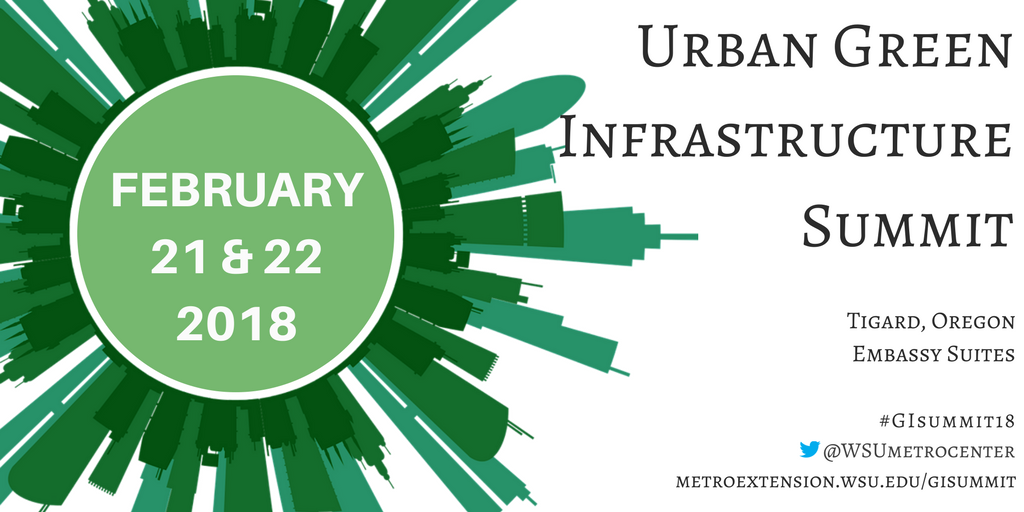
Urban Green Infrastructure Summit
February 21-22, 2018
Overview
Creating new collaborative networks, identifying research and education priorities, and sharing existing resources.
Metropolitan areas face many challenges, including those of urban flooding, storm-water management, air and water quality, urban heat islands, chronic diseases and public health issues, access to green spaces, and equity and social justice. Urban green infrastructure has a role in addressing all these urban issues.
Green infrastructure includes vegetation, soils, and other elements and practices that restore some of the natural processes required to manage water and create healthier urban environments (EPA. October, 2017). Green Infrastructure elements may be integrated in communities in single, small-scale applications or networks of practices spanning entire watersheds. Examples include land conservation, urban tree canopy, green roofs, green parking, green streets and alleys, permeable pavements, bioswales, planter boxes, rain gardens, rainwater harvesting and downspout disconnection.
Low Impact Development, Sustainable Stormwater Solutions and Green Infrastructure terms will be used interchangeably for the purpose of this Summit.
Structure
- Three working sessions exploring the latest developments in Green Infrastructure followed by small group break-out sessions to identify resources, build partnerships and build solutions. Summit themes include the following:
- Landscape scale challenges and management – land use planning, floods and floodplain management, climate resiliency, riparian and wetland management, open spaces
- Green Stormwater Infrastructure – runoff reduction, water quality treatment practices, urban trees and forests
- Non-traditional, Non-water Green Infrastructure Issues and Ideas – social justice and equity, public health, air quality and heat islands, contaminants of emerging concern, economics, regulations and incentives, outreach efforts.
- A fourth, research and education planning session, will develop applied research projects to address needs and opportunities identified at the Summit. (Feb 22: 3:30-7:00 pm) OPTIONAL.
Desired Outcomes
- Connect communities and university faculty to share existing resources, inform education and research priorities, and build new collaborative, problem-solving networks.
- Present research being conducted in the region.
- Present successes and challenges for implementing best practices in communities adopting urban/suburban green infrastructure.
- Build networks among communities and university faculty for future opportunities.
- City/County-Researcher-Extension: establish the networks to translate and share applied research to support municipality priorities with support from their local Extension programs.
- City/County peer-to-peer: allow sharing of lessons learned and best practices that may be adopted in other communities.
- University researcher / Extension peer-to-peer: establishing research collaborative networks to develop grant proposals, applied research projects.
Publications

Member Universities Involved:


Thank You Host Committee!


Thank You Sponsors!