
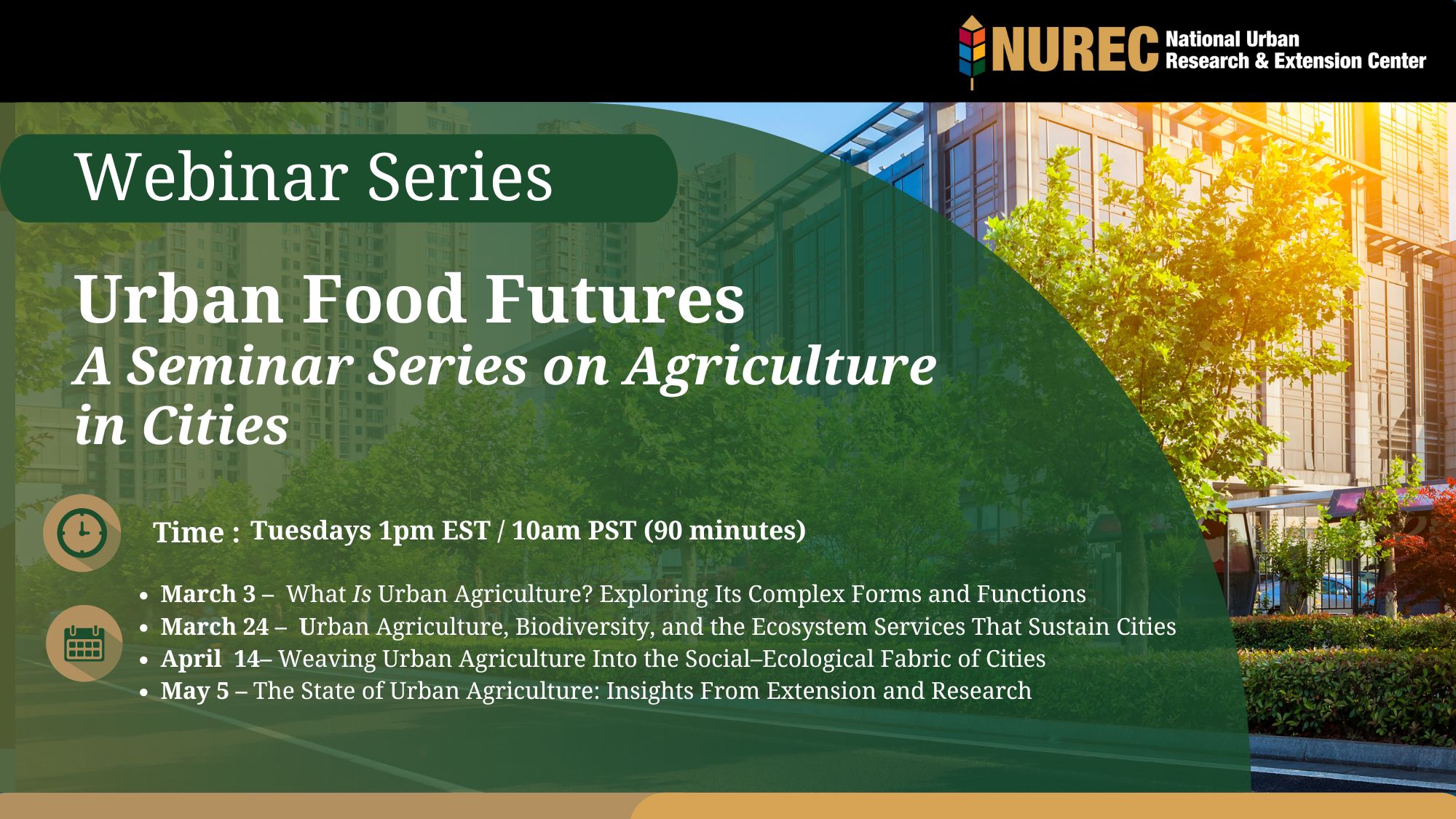
ICYMI – Urban Food Futures Seminar Series Kickoff
The following is a summary of Series Kickoff: Urban Agriculture, Biodiversity & Ecosystem Services, which took place on March 3rd, 2026, 10-11:30 am PST / 1-2:30 pm EST
Urban Food Futures: Growing Ideas for Resilient Cities
As cities continue to grow, questions about how—and where—we produce food are becoming more urgent. NUREC launched our new Urban Food Futures web series with a lively, wide‑ranging conversation that explored those questions from multiple perspectives, bringing together researchers, Extension professionals, and practitioners working at the intersection of food, cities, and communities.
Hosted by Joshua Arnold (UMass Amherst), the kickoff webinar featured two internationally recognized scholars whose work highlights the breadth of urban agriculture today: Dr. Miguel Altieri, Professor Emeritus at UC Berkeley and a leading voice in agroecology, and Dr. Most Tahera Naznin, Associate Professor at the University of Nevada, Reno, whose research focuses on indoor and controlled‑environment agriculture.
Together, their presentations reminded us that urban agriculture is not one thing—it is a spectrum of systems shaped by place, purpose, and people.
Food, Ecology, and Community—From the Ground Up
Dr. Altieri opened by situating urban agriculture within a rapidly urbanizing world. With most Americans projected to live in cities within the next few decades, food systems are increasingly disconnected from the people they serve. Urban agroecology, he argued, helps rebuild those connections.
Drawing on research from cities in the U.S. and globally, Dr. Altieri showed that community and peri‑urban farms can be remarkably productive while delivering benefits that go far beyond yield. Agroecological practices—such as intercropping, composting, and building soil biology—support diversified harvests, natural pest regulation, and long‑term resilience. Just as importantly, these spaces contribute to cooler neighborhoods, stronger social ties, and improved access to fresh, healthy food.
Realizing this potential, however, depends on secure land access, supportive policies, and knowledge‑sharing networks—areas where Extension and community‑based partnerships are especially critical.
Precision and Possibility Indoors
Turning to controlled environments, Dr. Naznin shared how advances in indoor and greenhouse farming open new opportunities for food production in cities facing extreme heat, limited water, or poor soil. Her research demonstrates how careful management of light, temperature, nutrients, and humidity can shape both crop performance and nutritional quality.
By adjusting lighting spectra or environmental conditions, indoor growers can influence plant structure, antioxidant levels, and consistency—factors that matter for both human health and market viability. At the same time, Dr. Naznin emphasized the real challenges facing this sector, including energy costs, workforce training needs, and competition with large‑scale produce imports.
Rather than replacing outdoor systems, she framed indoor agriculture as a complementary approach—one that can strengthen local food supply chains when paired with education, extension support, and targeted policy incentives.
Shared Challenges, Shared Work
Across both presentations and the discussion that followed, common themes emerged: land access, workforce development, and the need to better account for the social and environmental value of urban agriculture—not just its economic returns. Participants emphasized that research and Extension must work together to develop meaningful metrics, demonstration sites, and peer‑learning pathways that reflect real urban conditions.
Looking Ahead
The Urban Food Futures series is designed to support that collective work—connecting science to practice and elevating the full range of roles urban agriculture plays in community well‑being, climate resilience, and food security.
This kickoff session set the tone: urban food futures will be shaped not by a single model, but by collaboration across disciplines, systems, and communities. We look forward to continuing the conversation in the months ahead.
Speakers
Miguel Altieri, PhD
Dr. Miguel Altieri is a globally recognized pioneer of agroecology whose work has shaped sustainable agriculture theory and practice worldwide. Over four decades at UC Berkeley, he advanced ecological farming systems that center biodiversity, farmer knowledge, and resilience in food systems, with significant influence across Latin America and beyond.
Links:
Most Tahera Naznin, PhD
Dr. Most Tahera Naznin is an associate professor of urban and controlled‑environment agriculture at the University of Nevada, Reno, specializing in indoor farming, hydroponics, aquaponics, and climate‑smart food production systems. Her research and Extension work focus on optimizing year‑round crop production while improving food access and resilience in arid and urban environments.
Links:


