
Urban Food Resilience Knowledge and Practice Network
University Extension professionals play a vital role in supporting urban food systems through research-based education, outreach, and resource development—and by serving as connectors between research institutions and communities.
Our Urban Food Resilience Knowledge and Practice Network (KPN), currently led by Maggie Anderson Fasy, is a collaborative space for urban-focused Extension professionals, researchers, practitioners, and partners in local government and NGOs. Here, we foster dialogue, share cutting-edge research, and promote best practices in urban agriculture and sustainable food systems.
Below are some of the ways Extension professionals are advancing urban agriculture and food systems. If this work inspires you, we encourage you to engage with the Urban Food Resilience KPN. Learn how to join our Knowledge and Practice Networks here.
Learn more about NUREC’s Urban Food Resilience initiative here.
Expanding Urban Food Access
- Community Gardening Programs: Support the development of urban gardens that increase access to fresh, affordable produce and foster community engagement.
- Local Food Education: Offer workshops and cooking classes that highlight seasonal, locally grown ingredients and promote healthy eating habits.
- Food Distribution Initiatives: Partner with local organizations to establish farmers’ markets, CSA programs, and mobile food pantries in underserved neighborhoods.
Building Urban Agriculture Capacity
- Rooftop and Vertical Farming: Provide technical assistance and training for innovative growing systems that maximize space and productivity in urban environments.
- Building-Integrated Agriculture: Promote models that integrate food production into housing, schools, and public infrastructure.
- Urban Farm Incubators: Support new growers with land access, mentorship, and business development resources.
Enhancing Community Well-being
- Therapeutic Gardening: Use horticulture as a tool for mental health, stress reduction, and social connection.
- Youth Engagement: Develop school gardens and youth programs that teach food literacy, environmental stewardship, and entrepreneurship.
- Cultural Food Traditions: Celebrate diverse foodways and support culturally relevant growing practices in urban communities.
Education, Training & Workforce Development
- Urban Agriculture Training: Offer certification programs and hands-on training in sustainable agriculture, food systems, and green infrastructure.
- Career Pathways: Connect participants to jobs in food production, distribution, education, and policy.
- Community Education: Host public workshops on composting, soil health, food preservation, and climate-smart agriculture.
Supporting Environmental Sustainability
- Green Infrastructure Advocacy: Promote urban agriculture as a strategy for improving air and water quality, managing stormwater, and enhancing biodiversity.
- Waste Reduction & Composting: Educate communities on food waste reduction, composting, and circular food systems.
- Climate Resilience: Help cities adapt to climate challenges through urban greening, heat mitigation, and resilient food networks.
Strengthening Partnerships & Networks
- Collaborative Planning: Work with schools, nonprofits, healthcare providers, and local governments to design integrated food system strategies.
- Grant Support: Assist communities in securing funding for urban agriculture initiatives through grant writing and resource sharing.
- Community Needs Assessment: Conduct participatory assessments to identify food system gaps and co-create solutions with residents.

Josh Arnold
Urban Agriculture and Food Systems KPN Lead
Email: click to contact
Past webinar series
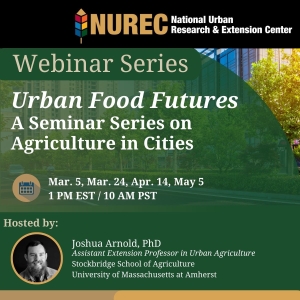
Urban Food Futures: A Seminar Series on Agriculture in Cities
March 3, March 24, April 14 and May 5, 2026
Tuesdays 1-2:30pm EST/10-11:30am PST
Overview:
Urban Food Futures is a national four‑part seminar series exploring the complexity, innovation, and impact of urban agriculture in U.S. cities. The series convenes researchers, Extension professionals, practitioners, and community partners to examine how urban agriculture operates as an ecological, social, and food‑system strategy.
Each 90‑minute session offers moderated discussions, case studies, and applied research that illuminate how urban agriculture contributes to resilience, community well‑being, and sustainable food futures.


